
Every summer I get the same question from peer colleagues running engineering teams: how many interns are you taking this year? Across the industry the honest answer is fewer, and this isn't a budget line that comes back next quarter.
At large public tech companies interns went from about 10% of engineering hires in 2023 to about 6% in 2025, roughly half, and new grads fell harder still, from nearly 3 in 10 to about 1 in 10 over the same two years.
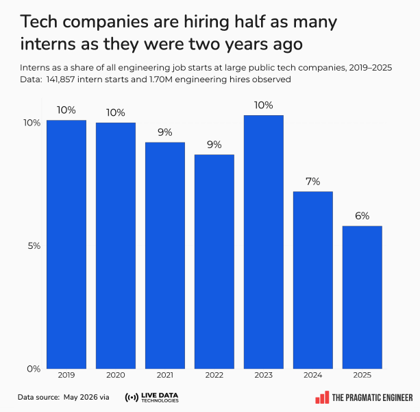
Downturns happen, but what's different this time is the shape of the recovery, because overall engineering hiring picked back up through 2024 and 2025 while intern intake kept falling anyway, and those two lines had never moved in opposite directions before, which is the tell that this is structural rather than another cycle.
It shows up in employment too, not only in the hiring mix, since a Stanford payroll study found that employment for software developers aged 22 to 25 fell about 20% from its late-2022 peak while developers over 30 in the same AI-exposed roles held steady or grew.
The loudest version of this story is Dario Amodei's, who warned that AI could "wipe out half of all entry-level white-collar jobs" within a few years, and while I think the headline is too clean, the direction is right and pretending otherwise helps no one.
What the junior role actually is now
The reframe that changed how I think about it starts with being honest about what that junior work was ever for.
AI now does the work juniors used to do - the small endpoint, the first pass at a bug - and that work was never really the point, it was the apprenticeship: the way someone learned the codebase, absorbed the review culture, and saw how decisions actually get made. Obviously AI is removing some of the routine work that once acted as an apprenticeship.
So the junior role stops being about output, and the job becomes taking a young graduate and turning them into a senior as fast as you can, which means the months in between aren't throughput you bill against but a deliberate learning path that you treat like a specialization, the same way you'd treat sending a mid-level engineer on a focused study program.
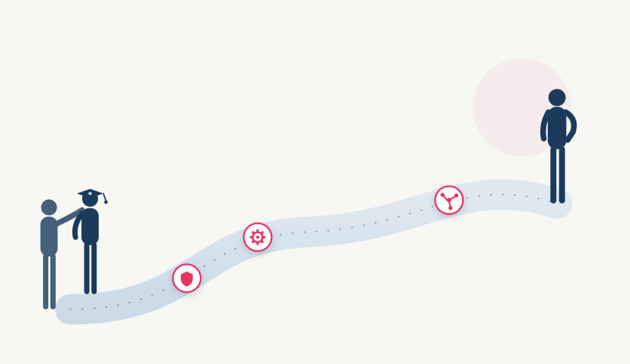
That one shift reorganizes the three debates everyone is having, because they aren't separate trends at all - they're the curriculum.
1. AI is raising the entry bar to the profession
The bar to be useful on day one moved up, simply because the easy work that used to be day-one work is gone.

Stanford's economists describe the mechanism cleanly: AI is automating "the codifiable, checkable tasks that historically justified entry-level headcount" while complementing the judgment work experienced engineers do, so the tasks that once made it cheap to hire a junior are exactly the tasks that automate first.
You hear the same thing from the people doing the hiring, like the CTO who put it plainly last December: "What we expect of entry-level roles would be what a mid-level engineer would be doing today." (Padmini Kao, Infoblox). More than half of job seekers already feel it, reporting that employers now expect entry-level candidates to arrive with mid-level experience.
This is also why courses and certifications carry more weight than they did five years ago, with AI literacy becoming a baseline rather than a differentiator, and if a graduate can't yet drive these tools well then that's the first thing the learning path has to fix.
Medicine has run on exactly this model for a century. A doctor finishes medical school and then spends years as a resident, then a fellow - genuinely practicing, treating real patients, on call at 3am - yet still formally in training, supervised, not yet a recognized specialist. The work is real and the learning is the point, at the same time. Nobody calls a first-year resident a failed consultant.
That's the right lens for a junior engineer. A junior is a practicing engineer who is also, openly, still in residency. The code they ship is real. The years around it are an apprenticeship we run on purpose - and, as in medicine, the supervision is a feature, not a cost.
So the junior role stops being about output. The job becomes taking a graduate and turning them into a senior as fast as you can. The months in between aren't throughput you bill against - they're a deliberate learning path you treat like a specialization.
2. Agency over knowledge
When the model can recall any API and draft any function in seconds recall stops being scarce, and what a person adds instead is drive - the ability to take an ambiguous problem, work out what's actually needed, and push it to done without being handed each step.
Andrej Karpathy compressed it to "Agency > Intelligence," and his follow-up is the part that should sit with any CTO: "Are you hiring for agency? Are we educating for agency?"
Knowledge isn't worthless, it's just no longer the moat, because the moat is now judgment - knowing which of the model's answers is right and being willing to own that call - so agency isn't a trait you only screen for at interview but something the learning path has to build on purpose, by handing juniors real decisions with real consequences earlier than we used to.
3. Domain experts are becoming technology virtuosos
The other side of the same coin is who can now build software at all.
A clinician, an analyst, or a lawyer who knows the AI tools can build the thing themselves, which is how a doctor friend of mine described it: "the technical barrier that once separated 'users' from 'builders' has largely disappeared," with functional custom tools built in an hour and no coding background. However, when I asked by medical doctor friend "Do you have the time to do it and code with an agent?", he stopped to think and had to admit to himself that he didn't have enough time for AI coding. What then is the solution?
For a junior engineer the lesson is direct, because generic coding skill is no longer the rare asset - the rare asset is deep knowledge of a domain plus the fluency to drive AI inside it, which means the specialization isn't only "learn to code well" but "go deep in a domain and learn to build in it." Maybe teamwork between domain experts and engineers matters even more in the agentic world.
It isn't all AI
I want to be careful not to blame everything on AIs.
Part of this is simply the economy, because the overall hiring rate has fallen back to levels last seen around 2013 and 2014, so some of the junior squeeze is a cold market rather than a robot.
Long-run demand for engineers is also still there, with the US Bureau of Labor Statistics projecting software developer roles growing about 15% through 2034, so nobody serious is saying the profession is closing - the first rung is narrower, not gone.
And there's a real risk in over-correcting, which is why AWS's CEO called cutting junior hiring because of AI "one of the dumbest things I've ever heard" and asked the obvious question: how does that work when, ten years out, no one on your team has learned anything? You don't get seniors without juniors, and if you skip the bottom rung you're borrowing against a pipeline you will badly need.
What I'd tell a CTO peer
So here's what I tell people running teams: invest in your interns the way you'd invest in someone you send on a specialization study, not as cheap hands for the backlog but as the next generation you're deliberately building, because that's the only way to keep continuity of business culture and attitude as the senior generation turns over.
Be concrete about it, which means giving them a domain rather than just tickets, pairing them with a senior who reviews their judgment and not only their code, teaching them to drive AI and to distrust it, and for the first year measuring their growth instead of their throughput.
Harvard Business Review put the trap in a single sentence, describing AI as "increasing the need for judgment and destroying the experiences that produce it," and since the work AI took away was the work that used to build judgment by accident, you now have to build it on purpose.
The market is telling us the junior role is shrinking, but I read it differently, because the junior role is being promoted: it used to be the cheapest way to get work done, and now it's the most important investment you'll make in the next decade of your engineering org.